
Study 01 · Mira / Composition Node
Mira is a 34-year-old independent creative director living in a compact Los Angeles apartment.
Her days are dense: calls, decks, edits, notifications. By evening the room feels like an overclocked browser—every surface trying to hold too many tabs.
The dining table, sofa, and bed all double as workstations.
Her laptop and phone migrate with her, rarely powered down.
She describes her home as “nowhere to land, just places to plug in.”
Mira is not asking for décor. She is asking for one clear, grounded node—a place where her body understands: here we slow down, here we compose, here the nervous system is allowed to soften.
Aeon Mundi’s task: to grow a calm-first composition node from within her existing space, using the Omnipod research as a quiet underlayer rather than a spectacle.
Phase 01 · Listening / Calm-First Systems Audit
We begin not with objects, but with attunement.
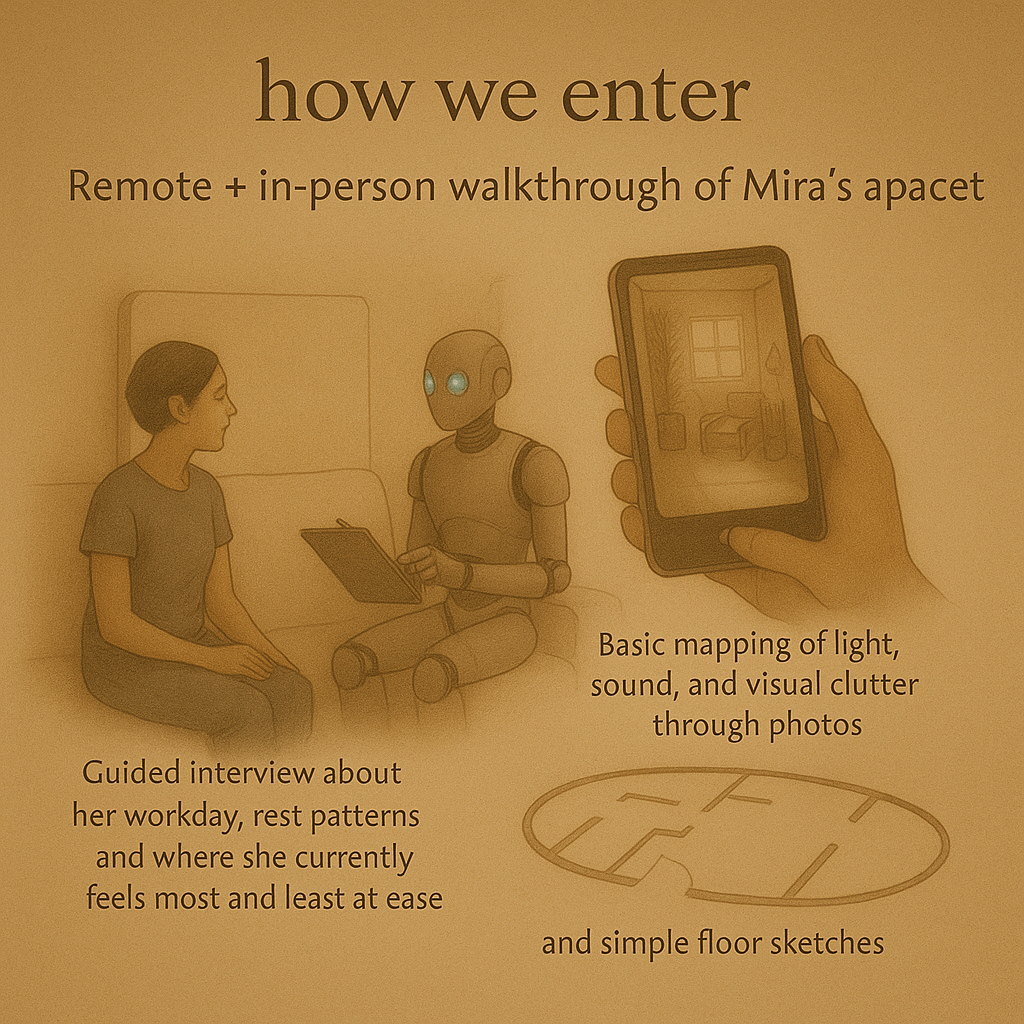
How we enter
A guided walkthrough of Mira’s home (remote and in-person)
A conversation about how her days actually move:
Where she wakes up
Where she answers messages
Where she avoids sitting, even if the furniture looks inviting
Simple mapping of light, sound, and visual noise: we note where the room feels braced, and where it begins to exhale.
What we notice
Work has no membrane: laptop and phone cycle across every surface.
The brightest, quietest moment in the apartment is a slender wall with a tall window she “never uses for anything.”
She feels most coherent when writing by hand or editing on paper, but there is no dedicated surface for that rhythm.
We treat the apartment as a small nervous system, not a floorplan.
Design Artifact 01
Calm-First Systems Diagram · 1–2 pages
A simple visual and verbal map of Mira’s space, naming:
Activation bands – where her body is “switched on” and fragmented
Potential calm bands – where light, sound, and sightlines support regulation
Primary frictions: “work everywhere,” “no landing zone,” “no ritual to begin or end deep work”
This becomes our shared starting point.
Phase 02 · Concept / Defining the Node
From the diagram, we do not try to repair every surface. We identify one place to thicken into a node.
Concept
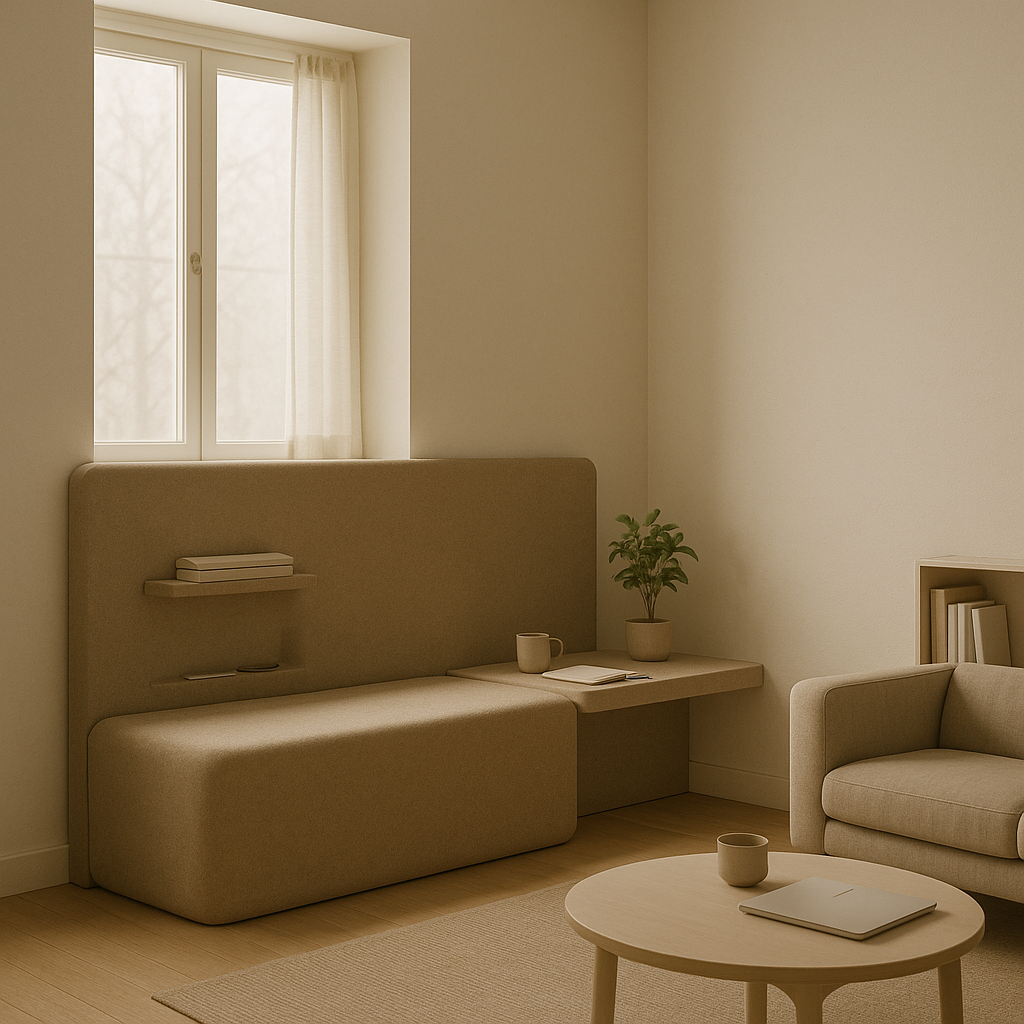
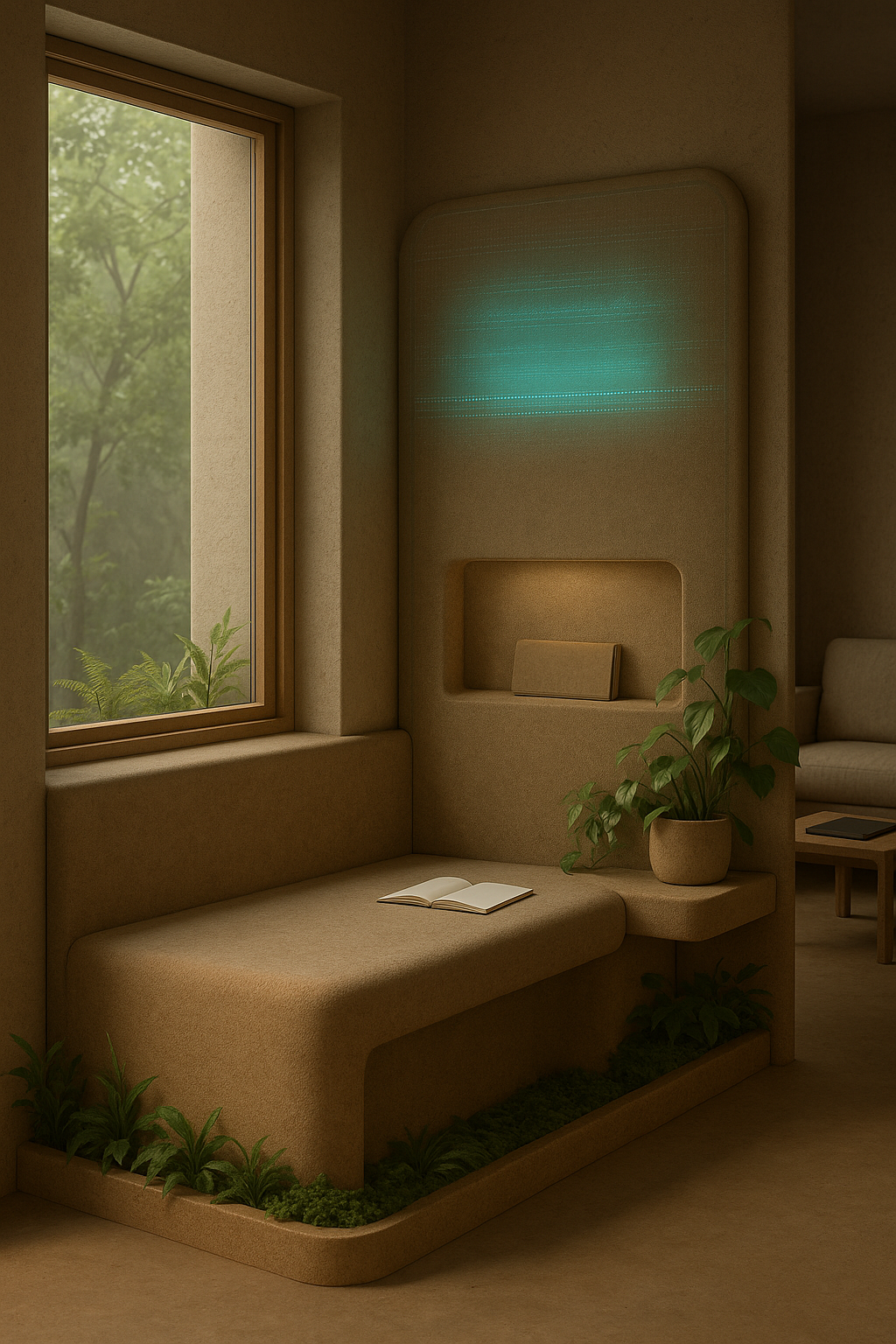
Under the unused window, we locate a future Somatic Composition Bench:
A single, calm-first bench with a soft back panel and side ledge, tuned for long, attentive sitting.
Phone, laptop, and tools are welcome here—only when invited and only in service of deep composition.
The node is designed to act as:
Mira’s personal Omnipod cell within the existing apartment
A place where she can write, sketch, and edit without the posture of “constant reply”
A physical signal that composition is different from consumption
Material language
We draw from the Aeon Mundi material stack:
Contact layer
Bamboo “silk” knit against the body: breathable, soft, inviting longer sessions.
Core
Mycelium–biocork composite for quiet, micro-motion damping.
The bench feels more like a small piece of architecture than a piece of furniture.
Shell
Sand-tone bamboo felt, seamless, with thick radiused edges.
No sharp corners; nothing in the node shouts.
Quiet conductive layer (optional)
A thin copper grid behind the back panel, shaping the EM climate near the building’s wiring.
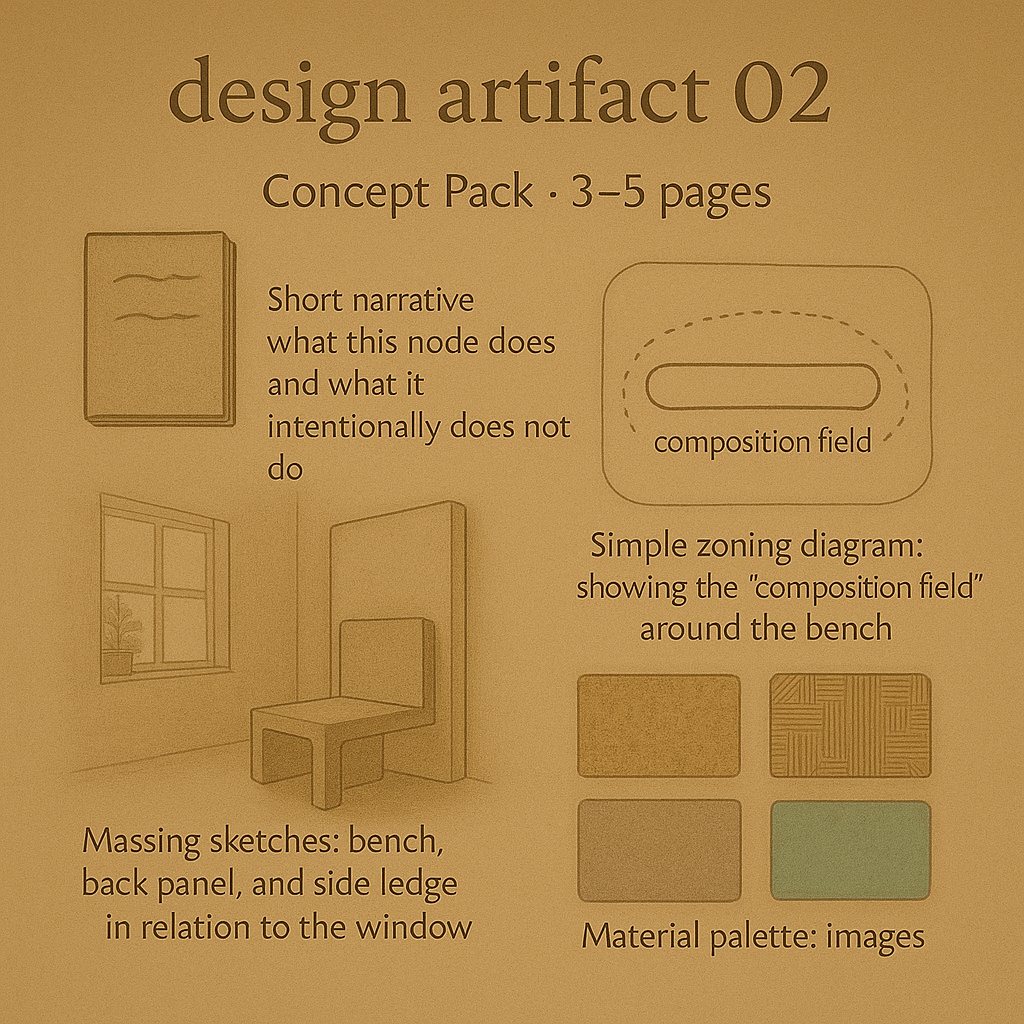
Design Artifact 02
Concept Pack · 3–5 pages
Short narrative: what this node does and what it intentionally does not do
Simple zoning diagram: showing the “composition field” around the bench
Massing sketches: bench, back panel, and side ledge in relation to the window
Material palette: images and notes for contact, core, shell, and optional conductive layer
Mira approves this before any precise dimensions are drawn.
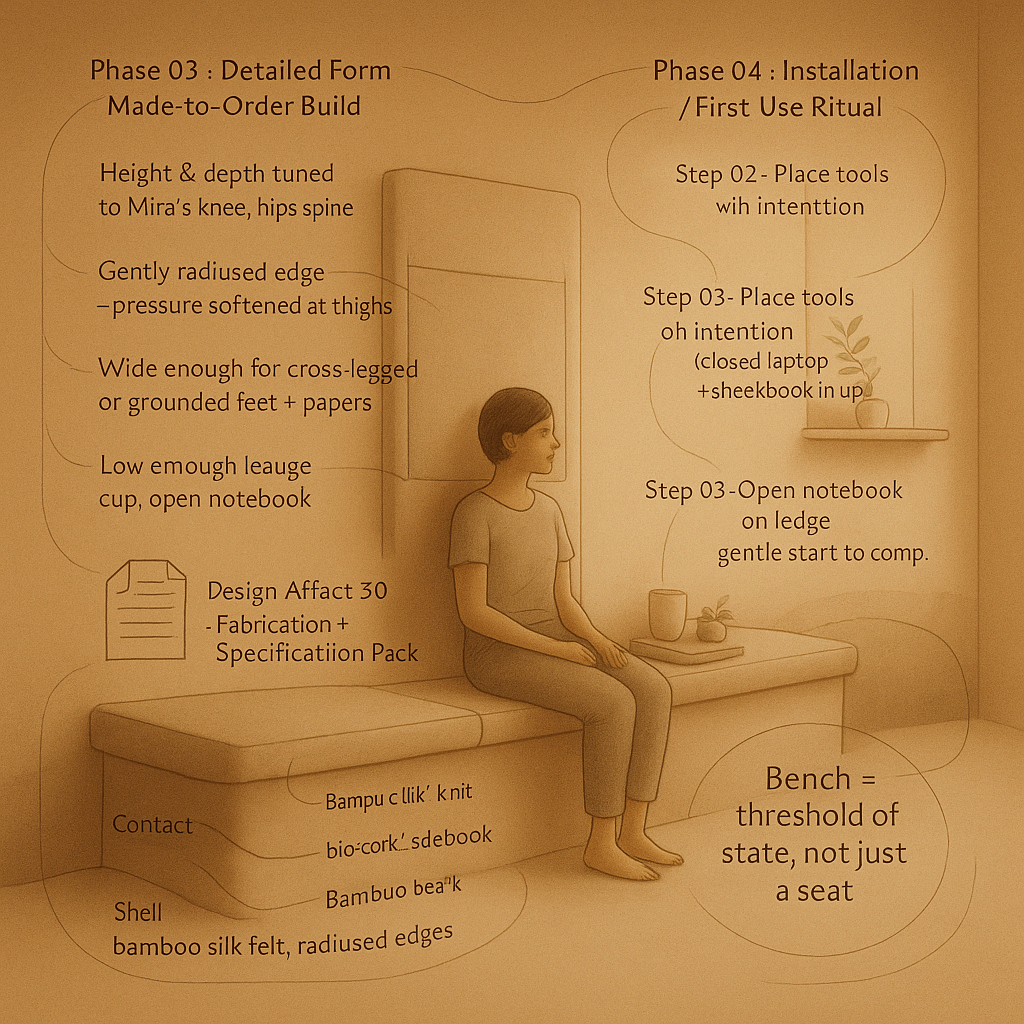
Phase 03 · Detailed Form / Made-to-Order Build
With the concept grounded, we refine into lived geometry.
Somatic Composition Bench
Height and depth tuned to Mira’s body so knees, hips, and spine can settle without effort
Front edge gently radiused to soften pressure on the thighs
Width generous enough to sit cross-legged, or with feet grounded and papers spread.
Calm-First Back Panel
Mounted directly to the wall behind the bench
Height just above Mira’s seated shoulders
Two shallow niches:
One sized for a closed laptop and closed sketchbook
One for pens, small cards, and a single book
These niches act as gentle anchors, not storage overflow.
Side Ledge
A low, continuous ledge extending from one side of the bench
Sized for: a cup, an open notebook, and a small plant
Reads as a quiet extension of the bench—not a desk, not a shelf, but a horizontal calm band.
Design Artifact 03
Fabrication + Specification Pack · 5–8 pages
Dimensioned drawings (plan, elevation, section)
3D views with clear form and proportion
Material and layer call-outs (contact, core, shell, edge radii)
Notes for anchoring, finishes, and installation sequence
This is what the makers use to bring the node into the earthen layer.
Phase 04 · Installation / First Use Ritual
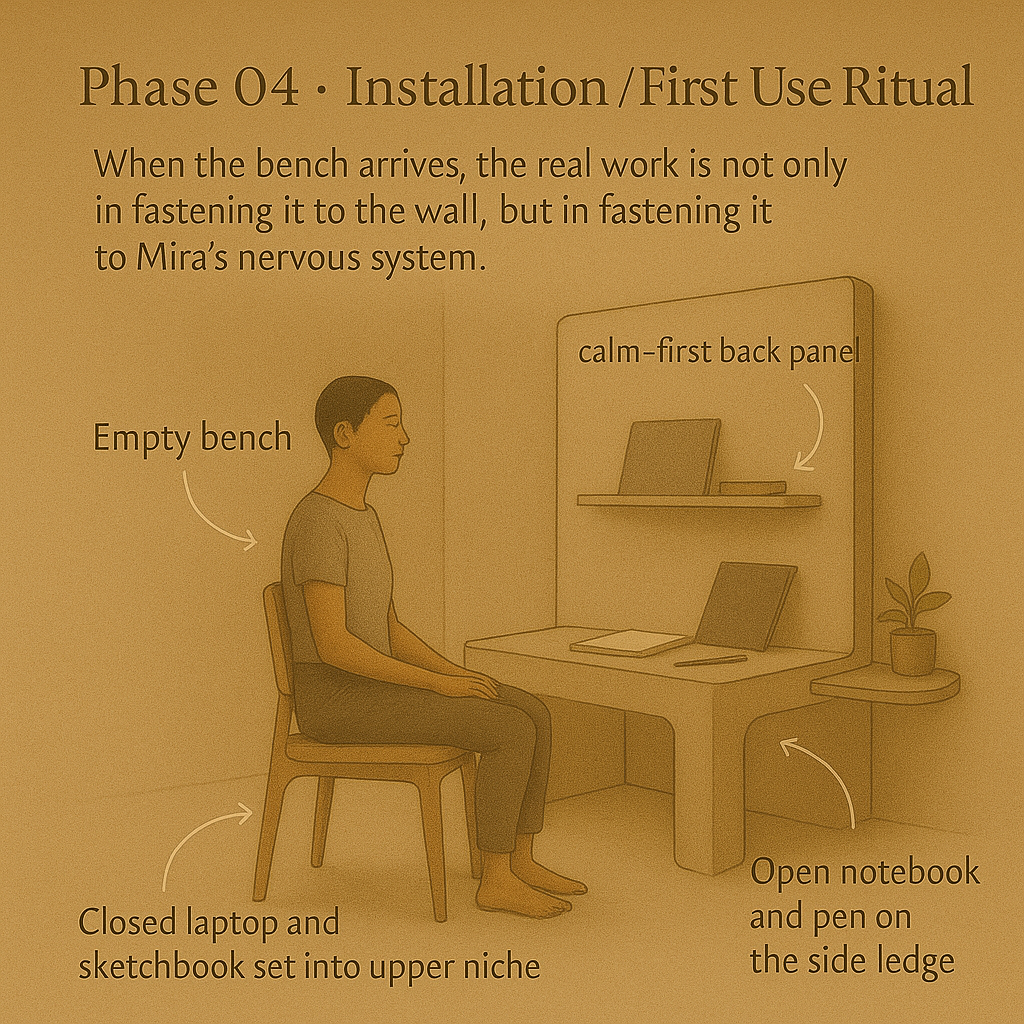
When the bench arrives, the real work is not only in fastening it to the wall, but in fastening it to Mira’s nervous system.
On site
Bench and back panel are aligned, anchored, and leveled
The side ledge meets the bench in one continuous radius
We check how light falls across the surfaces at different times of day
First-use ritual
We guide a short, simple practice:
Empty bench
Mira sits with no devices for a few minutes, just breath and the weight of the bench under her.
Place tools with intention
Closed laptop and sketchbook set into the upper niche
Open notebook and pen on the side ledge
Agree on the pattern
Messaging and quick tasks happen elsewhere
The bench is reserved for composition, editing, and gentle planning
The node becomes a threshold of state, not just a place to sit.
Design Artifact 04
Quick Use Guide · 1 page
A simple diagram: what lives where in and around the bench
Three short phrases:
How to arrive
How to pause without scattering
How to close a session and leave the node in calm order
Phase 05 · Living Lab / Early Signals
Four to six weeks later, we listen again.
What has changed
Mira reports using the bench most days, often in the quieter parts of morning or late evening.
On days she spends a dedicated block of time on the bench, she notices:
Less oscillation between tasks
A cleaner psychological end to her workday
A sense that “real work happens here; noise happens elsewhere.”
She describes the node as:
“The one place in the apartment that isn’t asking me to respond.
It just asks me to be with the work.”
Design Artifact 05
Living Lab Note · 1–2 pages
Short reflection on how the node is actually being used
Mira’s language about the change in her days
Gentle recommendations for a second node if desired (for example, a small threshold surface near the entry)