Omnipod Threshold
A threshold is not just a doorway.
In the Omnipod canon, a threshold is a small, calm intentionality node.
A surface, an alcove, a short passage where the pod reflects you back to yourself — your current state, your declared values, and the agreements you’ve made with the space and with one another.
Not as dogma.
As design priors.
The Omnipod Threshold is where a post-digital civilization begins in miniature:
one body, one pod, one corridor of coherence at a time.
From Overload to Omnipod: Why We Started This R&D
This research did not begin in a lab.
It began in transit: cross-country trains, short-term leases, co-living houses, anonymous rooms booked for a month at a time. It continued in grocery store aisles, on sidewalks between stations, and in the quiet after a long walk when the nervous system finally begins to down-shift.
Across those movements, one pattern kept repeating:
Our tools became more powerful.
Our infrastructures became louder, brighter, denser.
But our nervous systems did not keep up.
The Omnipod is our working answer to a simple question: What would it mean to build habitats where nervous-system stability, not throughput, is the primary design variable?
To approach that, we had to treat each daily condition — sleep, nourishment, light, sound, EM exposure, cohabitation rules — as research data, and then translate that data into architecture, furniture, and protocol.
The Threshold is the first place that translation becomes visible.
Omnipod as Post-Digital Habitat. We use the phrase “post-digital” deliberately.
Post-digital does not mean anti-digital.
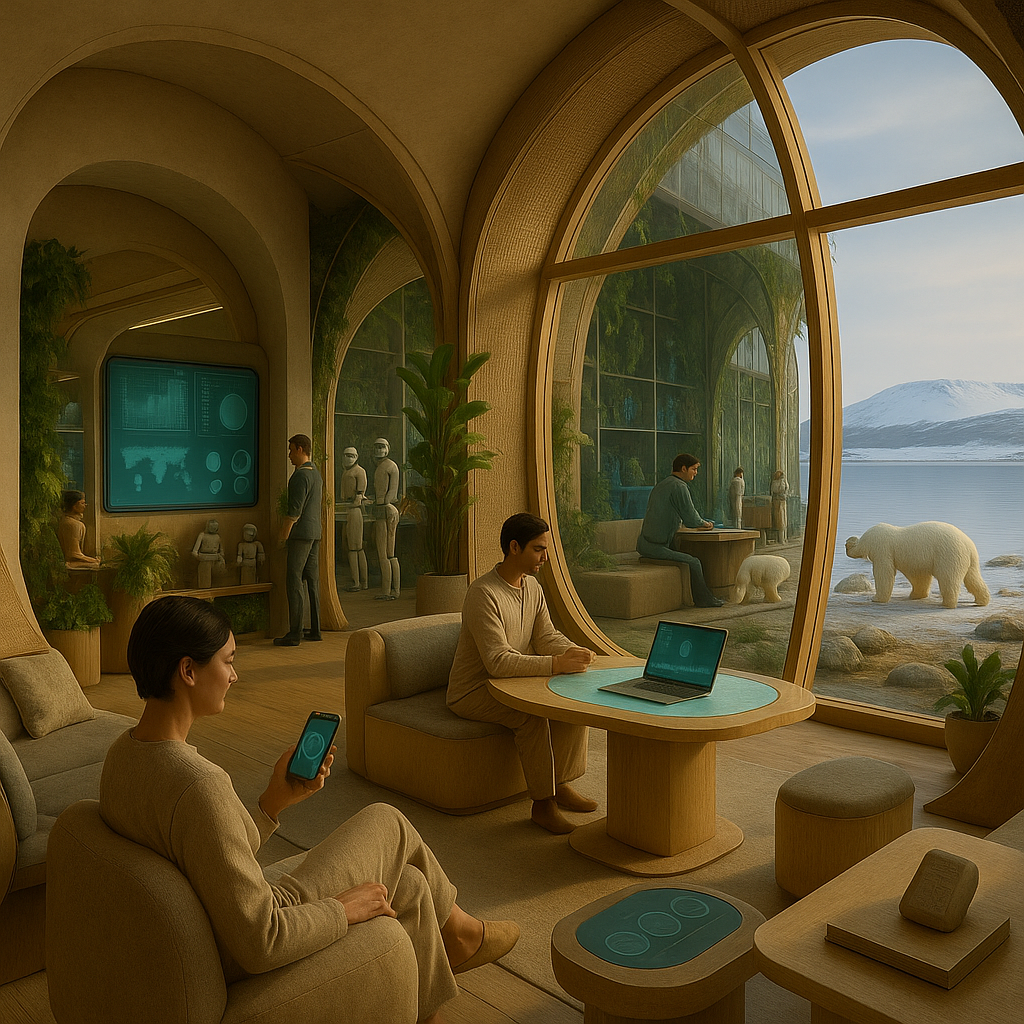
It means the digital layer has dissolved into the background, and the primary felt experience is: breathable, tactile, acoustically calm, and energetically coherent.
In a post-digital Omnipod, the phone and the network are no longer the “room” we live in. They are thin instruments embedded inside a thicker, earthen layer of support: Mycelium-based cores.
The Threshold is where you feel that difference immediately: your body knows it has crossed from civilization load into a quieter field.
Earthen Layer: Materials as Regulators, Not Decor
Across our R&D, materials are not aesthetic afterthoughts.
They are regulators. Post-digital Omnipods are not closed doors around imported food. They are fragments of living ecologies. Our nutrition R&D has been deliberately constrained: vegan, primarily raw or minimally processed, simple, low-complication, and aligned with a calm digestive profile rather than maximal caloric throughput.
From this, a pattern emerges:
We shift attention from “macros first” to **molecular and ecological loops.
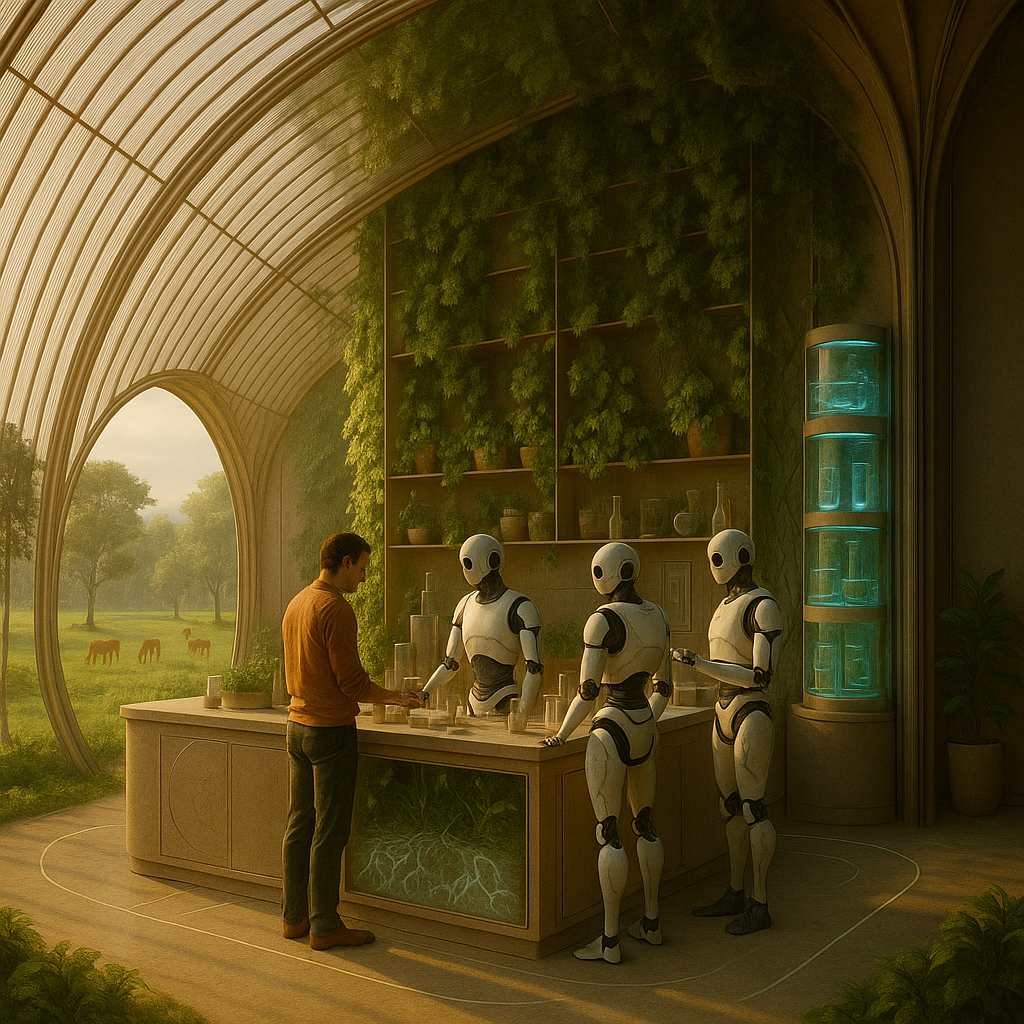
Mycelium cultures break down fiber-rich substrates and stabilize compost. Algae and micro-organism cultures transform light, water, and nutrients into dense, renewable biomass.
Fruits, grains, legumes, leafy greens, and herbs appear as visible byproducts of these deeper loops rather than standalone commodities.
Within the Omnipod Threshold, this shows up quietly: a small living wall of edible greens near the entrance, a visible but unobtrusive mycelium core or fruiting block, subtle cues that the food you’ll eat inside is part of a regenerative cycle, not an extractive supply chain.
The Threshold whispers: The resources that keep you alive are growing with you, not being taken from elsewhere and burned out of sight.
EM, Sound, and “Lines of Light”: Coherent Transit Bands
An Omnipod is not just a shelter.
It is a flux regulator.
Through the Non-Extractive Flux Protocol, each pod commits a defined share of its surplus — energy, attention, financial yield — to stabilizing systems beyond itself.
When you arrive at an Omnipod, the first few seconds matter.
The Threshold compresses the entirety of our R&D into a short, embodied sequence: As you come near, the lighting softens. City sound thickens and blurs.
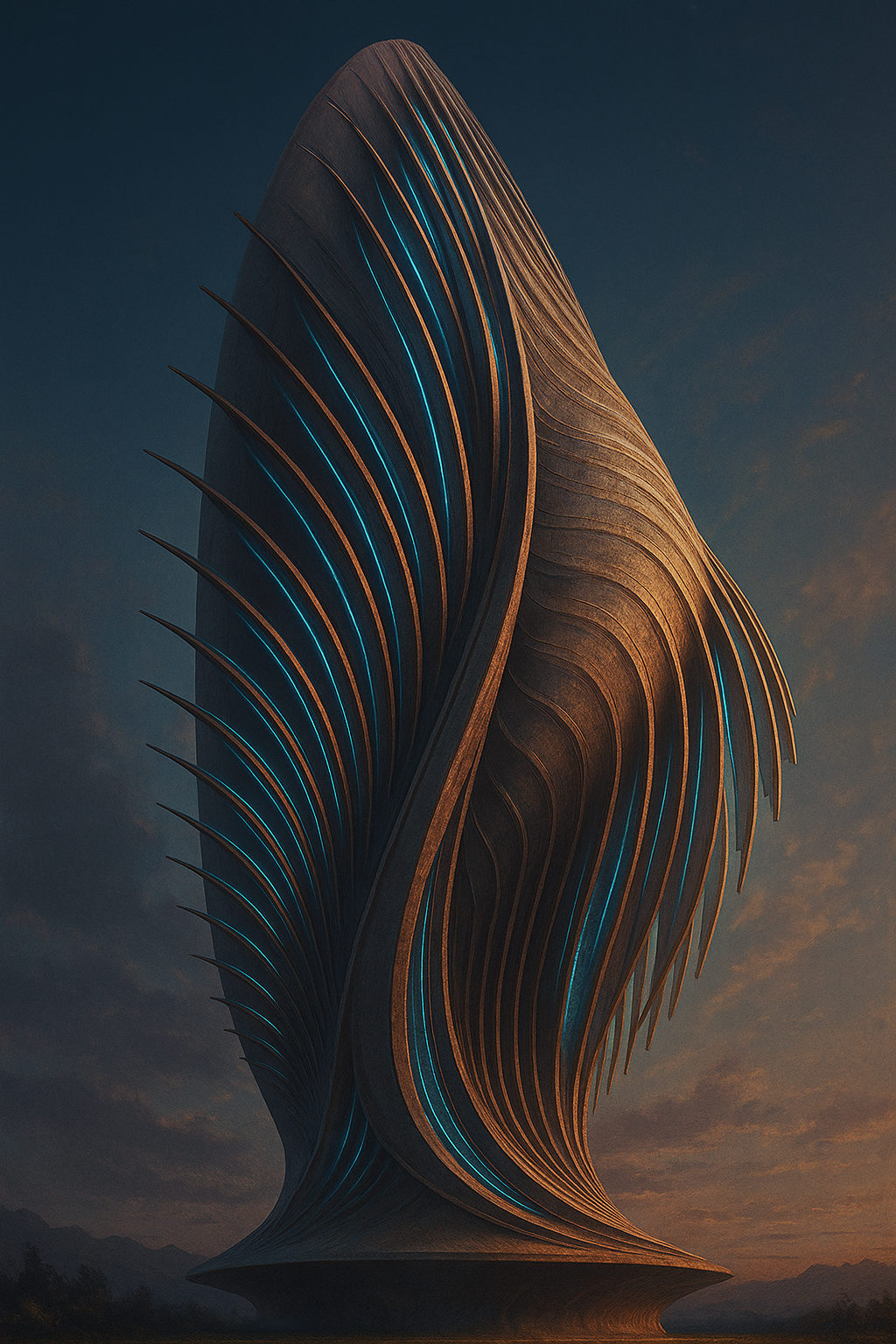
The facade reads less like a “smart device” and more like a quiet earthen form — smooth, rounded, with no glare. Your hand meets a warm, soft edge: bamboo felt over a mycelium-cork core with copper grid inside.
The surface holds your touch; it neither pulls nor repels.
Stepping in, you pass through a narrow CTB corridor.
EM interference drops. A low, barely perceptible sonic layer stabilizes your breath. The air feels slightly cooler and slower, with high-quality ventilation but no draft.
Orientation
A small, calm surface or niche offers you a moment: a place to place an object, a short prompt that remembers your last declared intention, a gentle cue to name your current state or select a mode: restoration, focused work, social co-creation.
Here, ancient cohabitation code has become interface:
Simple, minimal, but binding.
A glimpse of living ecology — a mycelium block fruiting in a protected chamber, a strip of edible greens, a trace of algae culture — quietly informs you that this is not a inert container.
It is a living fragment of a larger loop.
Within a minute, your nervous system has new information:
This environment is thick but breathable. It is listening, but not surveilling. It is aligned with your longevity, not just your productivity. This is the Omnipod Threshold.
A small piece of architecture where post-digital research becomes felt reality.
We treat each Threshold as a prototype of a future civilization.
If we can get this small passage right: the way it receives a body from a noisy street, the way it remembers and reflects a person’s declared values, the way it routes surplus into wider ecologies, the way it stabilizes nervous systems without numbing them,
then scaling to corridors, to clusters of Omnipods, to larger settlements becomes a question of replication and refinement, not reinvention.
The Omnipod Threshold is where our entire R&D journey — from train cars and grocery aisles, to mycelium cultures and EM fields, to ancient codes and future protocols —
condenses into a single lived moment:
You cross the line,
and the space quietly says:
You are held.
You are accountable.
You are not alone in the loop.