
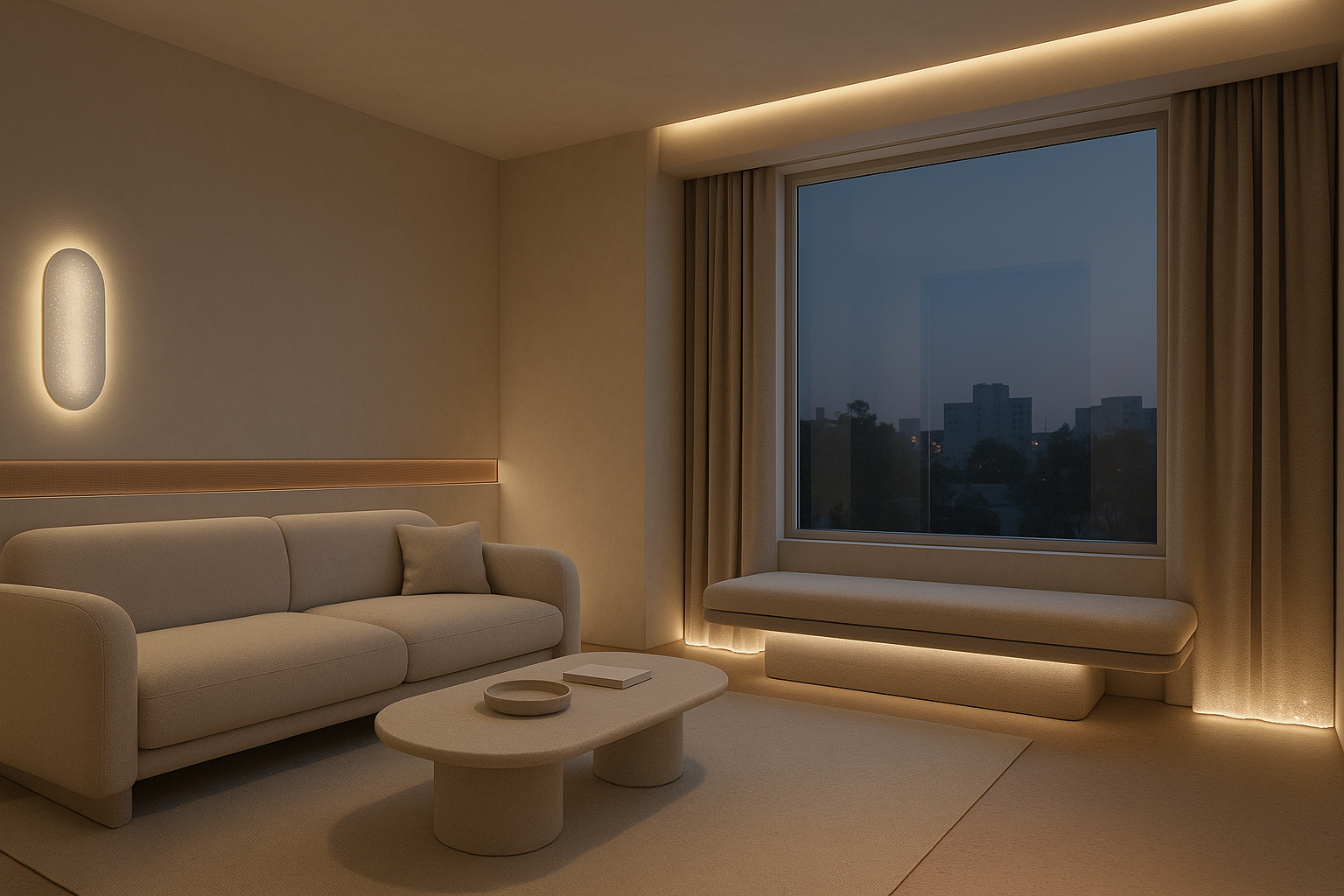
Calm-first Design Process
-
Calm-first design starts from a simple question:
What does this body, in this space, need in order to downshift out of survival mode—and stay there long enough for real thought, care, and creativity to emerge?
From there, everything else follows:
The nervous system is the client.
Not the brand, not the algorithm, not the real estate listing. We tune light, sound, material, and spatial rhythm around human regulation: heart rate, breath cadence, muscular tension, and subtle cues like how often you reach for your phone.The earthen layer is non-negotiable.
Every material and every protocol has to honor the living systems it comes from. In Aeon Mundi, the “products” are byproducts of a larger ecology: mycelium cores, plant-based fibers, algae loops, and closed nutrient cycles. The furniture, the pods, the walls—these are just physical interfaces for deeper regenerative systems.Technology becomes a quiet layer, not the main character.
Screens, sensors, and AI sit behind the membrane, not in your face. Calm-first environments are post-digital: they use advanced tools, but they feel like architecture and landscape, not gadgetry.Calm-first design is what allows Omnipods and other future habitats to be livable, not just buildable.
-
Across all of our work—Omnipods, benches, tables, loungers, corridors—the process repeats in three main phases.
Phase 1: Listening & Pattern-Mapping
We begin with a kind of quiet audit.
We listen to what your days actually look like: where your attention fractures, where your body braces, where you feel most restored.
We map flows and frictions: where light hits at the wrong angle, where sound leaks, where clutter or unresolved decisions accumulate.
We trace ecological and energetic inputs: the materials already present, the EM and sound environment, the subtle “tone” of the space.
Out of this, we draft a Calm-First Systems Diagram—a simple but precise map of your space as a living system: zones, thresholds, rhythms, and overload points.
Phase 2: Diagram → Material Stack → Form
Once we have the pattern, we translate it into things you can touch:
Diagrams become layers:
Contact surfaces, conductive layers, damping cores, light and sound organs, storage membranes, transit bands.We draw from our Aeon Mundi material library:
Bamboo “silk” knits and felts for contact and breathability
Mycelium–biocork or cork-rubber cores for micro-motion damping
Copper or conductive grids for EM field shaping and sensing
Spacer knits and porous structures to break harsh vibrations and let air move
From there, we sculpt specific forms:
a table that holds a conversation at a softer pitch, a pod that shields just enough noise to let your mind widen, a lounge that invites longer exhale breaths without you thinking about it.
Form is always downstream of nervous-system needs and material truth.
Phase 3: Living Lab → Refinement
Every piece we design is treated as part of a living lab:
We look at how bodies actually use the space over time: where people sit first, which surface becomes a de facto altar or landing pad, what gets avoided.
We refine dimensions, edges, and densities based on real behavior and subtle feedback—how long someone naturally lingers, how they sleep after time in the pod, whether they emerge more coherent or more scattered.
We treat the space as an interface to future Omnipods: a small prototype of the cohabitation codes and material ecologies we’ll need at larger scales.
This loop—listen, layer, prototype, refine—is the core of Aeon Mundi design.
-
This is the entry point for homes, studios, and small communal environments that feel the friction of current life and want to shift into a more coherent state.
In the Audit, we:
Conduct a calm-first intake
A structured conversation and visual walkthrough—live or remote—to understand your spatial rhythms, pain points, and aspirations. We’re looking for nervous-system signals, not just décor preferences.Map your Calm-First Systems Diagram
You receive a clear diagram of your space as a system: activation zones, recovery zones, thresholds, and proposed re-alignments. This includes notes on light, sound, storage, and behavioral cues.Propose one to three key interventions
Depending on your context, these may include:Reframed thresholds (entry surfaces, micro-altars, decompression corners)
Re-zoned work and rest areas
Suggestions for one or two signature pieces from the Aeon Mundi collection (or simple interim adjustments) that would shift your environment toward calm-first.
The Audit is intentionally modest in scope: it’s about clarity, not overwhelm. It gives you a map and a first set of moves, whether or not you commission custom pieces immediately.
Offer 2: Made-to-Order Calm-First Furniture & Pod Elements
For individuals, studios, and small spaces ready to embody calm-first design physically, we offer a collection of made-to-order pieces, each built on our material stack and Omnipod research.
These include, for example:
Somatic loungers and benches designed for long, stable sittings, reading, and quiet collaboration.
Dendrite and somatic dining / meeting tables that support slow meals, deep work, or small councils without feeling formal or rigid.
Early pod elements—sleep capsules, composition stations, and micro-niches—that act as “mini Omnipods” inside existing architecture.
Each piece is:
Calm-first by design:
Dimensions, densities, and edges are tuned for nervous-system regulation first, aesthetics second.Materially coherent:
Plant-based, mycelium-informed cores, bamboo textiles, and conductive layers chosen to be self-supporting and as non-extractive as we can currently achieve.Site-responsive:
We adapt the piece’s proportions and spec to your actual environment and the patterns revealed in your Audit, rather than dropping in an abstract object.
This is our current go-to-market bridge between speculative Omnipod research and tangible, livable objects.
4. Who This Is For & How to Begin
Aeon Mundi’s calm-first work is for people and places that:
Feel the cost of constant nervous-system overdrive, even if the space is “beautiful” on the surface.
Want environments that protect attention and life-force, not just display taste.
Are curious about future habitats—Omnipods, post-digital living, regenerative material ecologies—but need an accessible starting point inside an existing home, studio, or small communal setting.
The first step is simple:
Begin with a Calm-First Interior Systems Audit, then—if it resonates—let one or two made-to-order pieces become the first physical nodes of a new pattern.
From there, your space quietly shifts from “somewhere you happen to live or work” into a small, calm, intentional node in a larger Omnipod network.
That’s the arc of our current go-to-market: listen deeply, adjust gently, build only what your nervous system and the earthen layer can genuinely support.